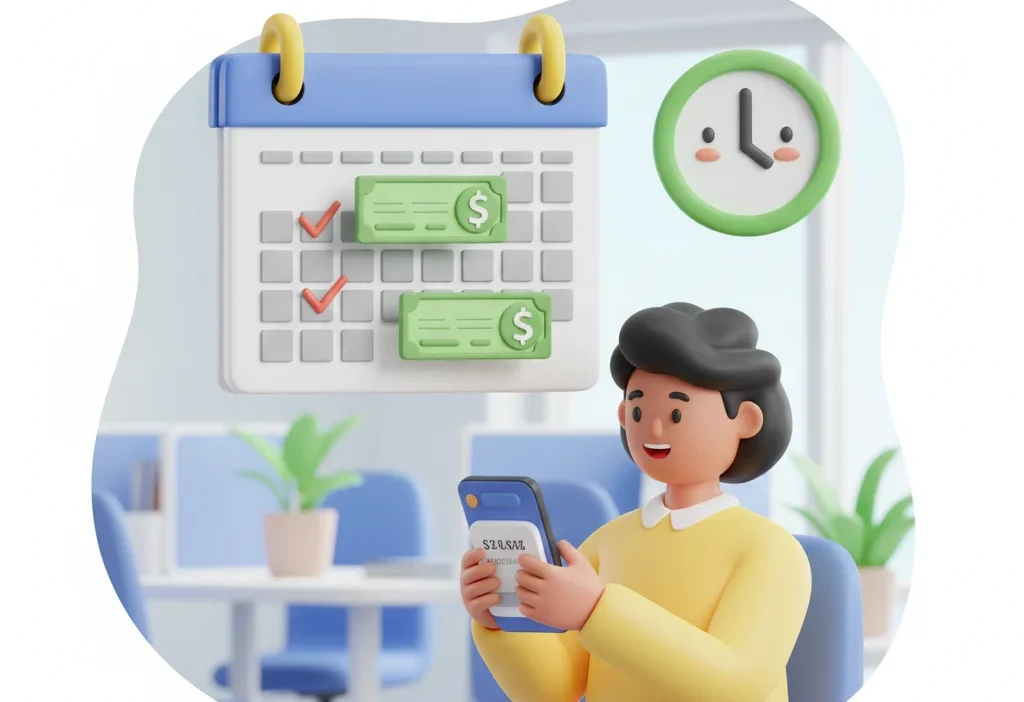
“Biweekly pay” means you are paid every two weeks, typically resulting in 26 paychecks per year. It is a standard, formal payroll schedule used by many employers.
Imagine it’s your first “real” job offer. You’re thrilled about the role, the team, and the salary. Then, in the hiring paperwork, you see the phrase: “Pay Schedule: Biweekly.” Your brain does a quick stutter. Wait, does that mean twice a week? Or every two weeks? You don’t want to ask and seem out of the loop, but getting paid is kinda important. If you’ve ever paused at the term “biweekly,” you’re not alone. It’s one of those finance words that sounds straightforward but can cause genuine confusion.
In the world of work and personal finance, understanding your pay schedule is as crucial as knowing your salary. It affects how you budget, when bills are due, and your overall cash flow. Let’s decode what biweekly pay really means, how it works, and how it stacks up against other pay schedules, so you can manage your money with confidence.
🧠 What Does Biweekly Pay Mean?
In the context of payroll and employment, “biweekly” unequivocally means “every two weeks.” The prefix “bi-” signifies “two,” and “weekly” refers to a week. Put them together, and you get a recurring event that happens once per two-week period.
Employees on a biweekly pay schedule receive their wages every other week, on a specific day of the week (e.g., every other Friday). Because there are 52 weeks in a year, this schedule results in 26 pay periods annually.
Example Sentence: “Our company runs on a biweekly pay cycle, so I get paid every other Friday, which helps me plan my budgeting for the month.”
In short: Biweekly Pay = Paid Every Two Weeks = 26 Paychecks Per Year.
📱 Where Is the Term “Biweekly Pay” Commonly Used?
This isn’t slang for social media; it’s formal financial and HR terminology. You’ll encounter it in:
- Official Employment Documents: Offer letters, employment contracts, and employee handbooks.
- HR & Payroll Systems: When you log into your company’s payroll portal to view pay stubs.
- Banking & Budgeting Apps: In transaction descriptions and when setting up automatic bill payments.
- Workplace Conversations: With your manager, HR representative, or colleagues when discussing payroll.
- Personal Finance Forums & Articles: Where people discuss budgeting strategies for different pay schedules.
Tone: It is a formal, professional term. Using it correctly shows financial literacy in workplace settings.
💼 Biweekly Pay in Practice: A Simple Breakdown
Let’s make it concrete. Assume your annual salary is $52,000 and you are paid biweekly.
- Pay Period: Covers 80 work hours (assuming 40-hour weeks).
- Gross Pay per Check: $52,000 / 26 pay periods = $2,000 (before taxes and deductions).
- Payday: You receive this $2,000 every other Friday.
The key thing to remember is the two “three-paycheck months.” Since you get 26 checks a year and there are only 12 months, two months out of the year will have three paydays instead of two. This is a great opportunity for extra savings or paying down debt!
Biweekly Pay vs. Other Pay Schedules
It’s easiest to understand biweekly pay by comparing it to other common schedules.
| Pay Schedule | Frequency | # of Paychecks/Year | Key Characteristic |
|---|---|---|---|
| Biweekly | Every two weeks | 26 | Consistent schedule; two months have three paydays. |
| Semimonthly | Twice a month (e.g., 15th & last day) | 24 | Pay dates vary (could be Wed/Fri); paychecks may be slightly larger. |
| Weekly | Every week | 52 | Frequent pay; easier for week-to-week budgeting. |
| Monthly | Once a month | 12 | Largest checks; requires the most disciplined monthly budgeting. |
✅ When to Use and When Not to Use a Biweekly Budget
✅ When a Biweekly Budget Works Best:
- If you are paid biweekly: It’s the most natural alignment.
- For managing consistent bills: You can schedule bills to come out right after each payday.
- For building savings: The two “extra” third paychecks can be automatically directed to savings.
- When you prefer predictable cash flow: Knowing a check arrives every other Friday simplifies planning.
❌ When a Different Budget Approach Might Be Better:
- If you have highly irregular income (e.g., freelancing, commission-based work).
- If your major bills are all due at once mid-month, and aligning with two paychecks is tricky.
- When you first start, if it feels too complex. Starting with a simple monthly budget can be easier.
Comparison Table: Budgeting for Your Paycheck
| Context | Example Phrase/Strategy | Why It Works |
|---|---|---|
| Biweekly Budgeting | “I split my mortgage into two payments, paid from my first and second paycheck each month.” | Aligns expenses directly with income flow. |
| “Third Check” Strategy | “My June and December third paychecks go straight to my IRA.” | Harnesses the bonus paychecks for major financial goals. |
| Monthly Budgeting | “I calculate all my expenses for the month, then divide by two to know what to set aside from each check.” | Provides a big-picture view, regardless of pay frequency. |
🔄 Similar Pay Schedule Terms or Alternatives
Here’s a quick guide to related payroll terminology so you’re never confused again.
| Term | Meaning | Key Difference from Biweekly |
|---|---|---|
| Semimonthly | Paid twice per month (24x/year). | Dates vary (e.g., 15th & 30th). Pay period isn’t always 80 hours. |
| Weekly | Paid once per week (52x/year). | More frequent, smaller checks. |
| Monthly | Paid once per month (12x/year). | Less frequent, much larger checks. |
| Net Pay | The amount you “take home” after taxes/deductions. | This is what hits your bank, not your gross biweekly amount. |
| Pay Period | The span of time for which you are being paid. | For biweekly, this is a fixed 14-day/80-hour block. |
❓ FAQs About Biweekly Pay
Q: Does biweekly mean twice a week or every two weeks?
A: In payroll, it always means every two weeks. The term for twice a week is “semiweekly.”
Q: How many biweekly pay periods in 2024/2025?
A: Most years have 26 biweekly pay periods. However, due to calendar alignment, some years (like 2025) have 27 biweekly pay periods if your first check was in early January. This is a rare “payroll leap year.”
Q: Is biweekly pay better than semimonthly?
A: It depends. Biweekly is simpler (same day, consistent hours). Semimonthly paychecks can be slightly larger (24 vs. 26), but paydays fall on different days of the week.
Q: What months have 3 biweekly paychecks in 2024?
A: This depends on your specific pay calendar. For many companies with Friday paydays, in 2024 it is May and November.
Q: How do I budget on biweekly pay?
A: The best method is to build your budget around two paychecks per month. Treat the two “third paychecks” you get each year as bonus money for savings, debt payoff, or non-monthly expenses.
💎 Conclusion
Decoding what biweekly pay means—every two weeks for a total of 26 (sometimes 27) paychecks a year—is a fundamental step in adulting and taking control of your finances. It’s more than just a word on your offer letter; it’s the rhythm of your income. By understanding its cycle, especially the power of the two “bonus” paychecks, you can transform your budgeting from a reactive scramble into a proactive plan.
So the next time you see “biweekly pay,” you can nod knowingly. It’s your predictable, every-other-Friday financial partner, ready to be managed wisely for a more secure and planned financial future. Now go check your calendar and mark those paydays

Sophia Hayes is an expert in dream psychology and subconscious symbolism with over 10 years of experience in spiritual research and metaphysical sciences. Her passion lies in helping readers unlock the hidden messages within their dreams to improve emotional healing and personal growth. Through her deep understanding of spiritual symbolism, Sophia provides insightful, research-based interpretations that bridge science and spirituality. At DreamingSign.com, she shares transformative guidance to help individuals understand their dreams and connect with their higher selves.