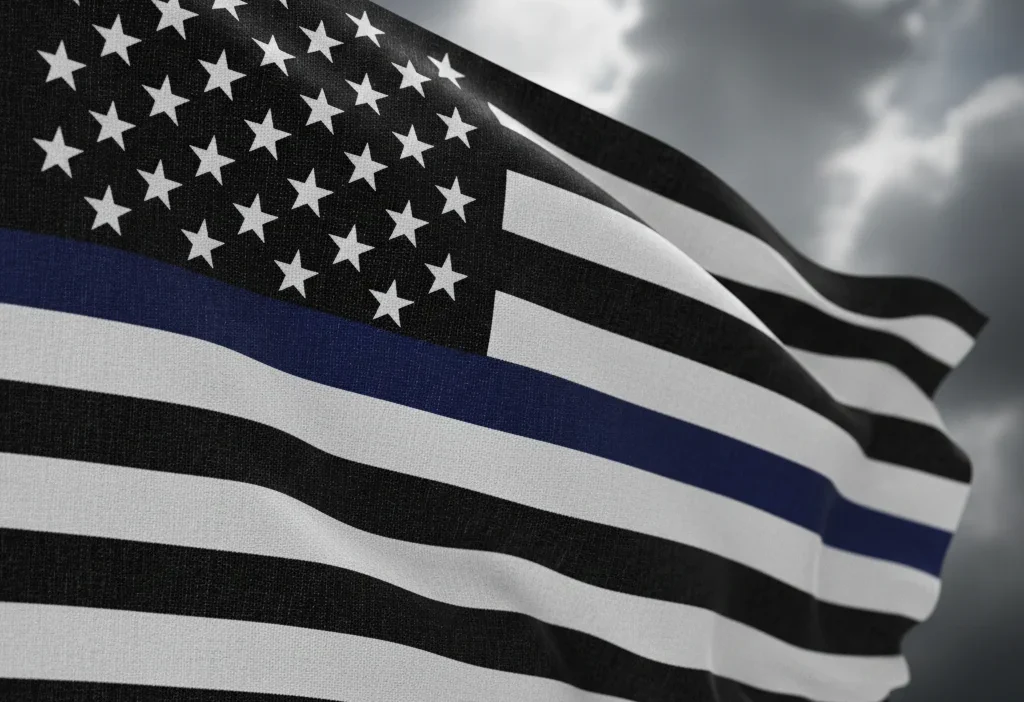
The black and white American flag, often referred to as the “Thin Blue Line” flag, is a symbol primarily used to show support for law enforcement. It represents the role of police as the line between order and chaos. However, its meaning has become complex and controversial, seen by some as a patriotic emblem and by others as a political statement.
Ever been scrolling through social media and seen a profile picture framed with a stark, black-and-white American flag? Or maybe you’ve spotted a decal on a truck bumper that twists Old Glory into a monochrome symbol with a single blue stripe. It stops you in your tracks. It looks familiar, yet profoundly different. For a moment, you might wonder if it’s a filter, an artistic choice, or something with a deeper message. That moment of confusion is exactly where millions find themselves. This isn’t your typical text slang like “SMH” or “FR,” but in today’s digital world, symbols are the ultimate shorthand—carrying dense, often charged meanings in a single image. Let’s unravel the story behind this powerful and polarizing emblem.
🧠 What Does the Black and White American Flag Symbolize?
This flag is a deliberate modification of the standard U.S. flag. Its design is symbolic:
- Black and White Fields: The traditional red stripes become black, often said to represent the fallen officers, public remembrance, or a state of mourning. The white stripes and stars on a black field create a stark, solemn appearance.
- The Blue Stripe: A single blue horizontal stripe stands out. This is the “Thin Blue Line.” The concept is that law enforcement officers, in their blue uniforms, are the thin line that protects the community from violence and lawlessness.
The phrase “Thin Blue Line” dates back decades, but the flag’s popularization is more recent, gaining massive traction after high-profile police shootings and the subsequent social justice movements. It’s used to express solidarity, memorialize officers killed in the line of duty, and signal a “back the blue” mentality.
In short: Black & White American Flag = The “Thin Blue Line” Flag = A symbol of law enforcement support, mourning, and political identity.
📱 Where Is This Symbol Commonly Used? 🗺️
This isn’t a symbol confined to a single app; it’s a real-world emblem that has flooded digital spaces.
- Social Media & Profile Frames: 🇫🇷 Used as Facebook profile frames, especially after incidents involving police. On Instagram and TikTok, it appears in bios, story graphics, and as backgrounds.
- Bumper Stickers & Vehicle Decals: 🚗 Perhaps the most common physical sight—on trucks, cars, and motorcycles.
- Clothing & Merchandise: 👕 Hats, T-shirts, and flags sold online and at rallies.
- Protests & Rallies: 📢 Flown at political rallies, pro-police gatherings, and counter-protests.
- Context Warning: Its use is highly context-dependent. It is not a casual or neutral symbol. It carries significant political and social weight. Using it signals a specific alignment, often interpreted as a conservative or “back the blue” stance.
💬 Examples of the Symbol in Context (Digital & Real World)
Seeing it in action helps clarify its use. Here’s how the symbolism plays out:
- As a Social Media Statement:
- Post: A news article about a local officer retiring.
- Comment: “Thank you for your service. 🏴 #ThinBlueLine” [Flag emoji used as support]
- In a Heated Online Debate:
- User A: “The system needs serious reform.”
- User B: Changes profile picture to the Thin Blue Line flag and replies: “This is for the heroes who run toward danger.”
- As a Memorial:
- Facebook Post: “RIP Officer. Gone but never forgotten. 👮♂️🕊️” [Accompanied by an image of the flag at half-mast].
- As a Political Identifier:
- At a Rally: A speaker stands in front of a large draped Thin Blue Line flag while giving a speech on “law and order.”
- In Offline Signaling:
- A homeowner flies the flag on their porch, signaling their views to the neighborhood.
✅ When to Use and When to Avoid This Symbol
This isn’t about casual etiquette but understanding profound social signaling.
✅ When It Might Be Used (By Supporters):
- At a law enforcement officer’s funeral or memorial service.
- During Police Week or similar observances.
- To express personal support for a family member or friend in law enforcement.
- At a pro-police rally or event.
❌ When to Avoid or Seriously Consider Its Impact:
- In an attempt to be “neutral patriotic”—it is not a neutral symbol.
- In communities or conversations centered on racial justice or police accountability (it will likely be seen as inflammatory).
- Without a deep understanding of its current cultural and political connotations.
- In official government or institutional settings where displaying altered national flags may be prohibited.
| Context | Example of Use | Why It’s Loaded |
|---|---|---|
| Officer’s Funeral | The flag draped over a casket. | A solemn, widely understood memorial tradition. |
| Social Media Bio | The flag emoji/icon next to a username. | A public, personal-political statement. |
| Bumper Sticker | On the back of a personal vehicle. | A mobile, public declaration of alignment. |
| Protest/Counter-Protest | Waving the flag at a demonstration. | A direct symbol of opposition to the other side’s message. |
🔄 Similar & Related Symbols
The “Thin Blue Line” flag is part of a family of “thin line” flags that use a similar black-and-white design with a colored stripe. Each supports a different emergency service or cause.
| Symbol / Flag | Stripe Color | Represents / Meaning | Key Context |
|---|---|---|---|
| Thin Red Line | Red | Firefighters | Support for fire services. Less politically charged. |
| Thin Green Line | Green | Federal agents, military, border patrol | Support for federal law enforcement and the military. |
| Thin Yellow/Orange Line | Yellow/Orange | Dispatchers, Search & Rescue | Support for emergency response communicators. |
| Thin White Line | White | Emergency Medical Services (EMS) | Support for paramedics and EMTs. |
| Thin Silver Line | Silver/Gray | Corrections Officers | Support for prison guards and officers. |
🤔 Understanding the Dual Perception
To fully grasp this symbol’s power, you must hold two conflicting truths in mind:
- For Supporters: It is a badge of honor, solidarity, and remembrance. It says, “I see the danger you face and stand with you.” In this view, criticism of the flag is seen as an attack on police officers themselves.
- For Critics: It is a symbol of defiance against police accountability and racial justice movements (like Black Lives Matter). It can represent a “us vs. them” mentality and is seen as co-opting the national flag for a partisan agenda. For them, it can feel intimidating and exclusionary.
This duality is why its appearance stops a scroll and sparks intense debate. It’s rarely just a flag; it’s a conversation starter—or ender.
❓ FAQs
Q: Is the black and white American flag legal?
A: Yes, it is protected as free speech under the First Amendment. However, its display may be against regulations on government property or in certain official capacities.
Q: What does an all black and white American flag (no colored stripe) mean?
A: An entirely black-and-white American flag (sometimes with a muted blue canton) is generally used as a tactical or “no quarter” flag. It has military origins and is popular in tactical communities. Its modern interpretation is often “no surrender,” but it can also be seen as a generic patriotic alternative to the more politically charged “thin line” flags.
Q: Do police departments officially use this flag?
A: Some do, and some have banned it. Many individual officers and supporters use it personally, but official department policies vary widely. Some see it as a morale booster, while others see it as a divisive symbol.
Q: Has the flag’s meaning changed over time?
A: Dramatically. Originally a niche memorial symbol, it was massively popularized after 2014-2015. Its association with broader political movements, especially after 2020, has shifted its primary public perception from a support symbol to a political identity marker for many.
Conclusion
The black and white American flag is a masterclass in how a simple design can become a vessel for immense cultural meaning. More than just an aesthetic choice, it is a dense packet of information—speaking to loyalty, loss, political stance, and identity. Understanding it requires looking beyond the graphic to the complex, often painful, conversations about community, safety, justice, and patriotism happening all around us. Whether you see it as a tribute or a provocation, its power to command attention and evoke emotion is undeniable. The next time you see it, you’ll understand the full weight of the statement being made.

Olivia Bennett is a lifestyle researcher and holistic wellness advocate specializing in mindfulness, dream healing, and manifestation techniques. With a background in psychology and meditation therapy, Olivia writes to empower readers to achieve mental clarity and emotional balance through dream awareness. Her articles provide practical tips, spiritual insights, and real-life strategies for boosting intuition and creating a more meaningful life. Olivia’s work at DreamingSign.com inspires readers to use dreams as a tool for personal transformation.