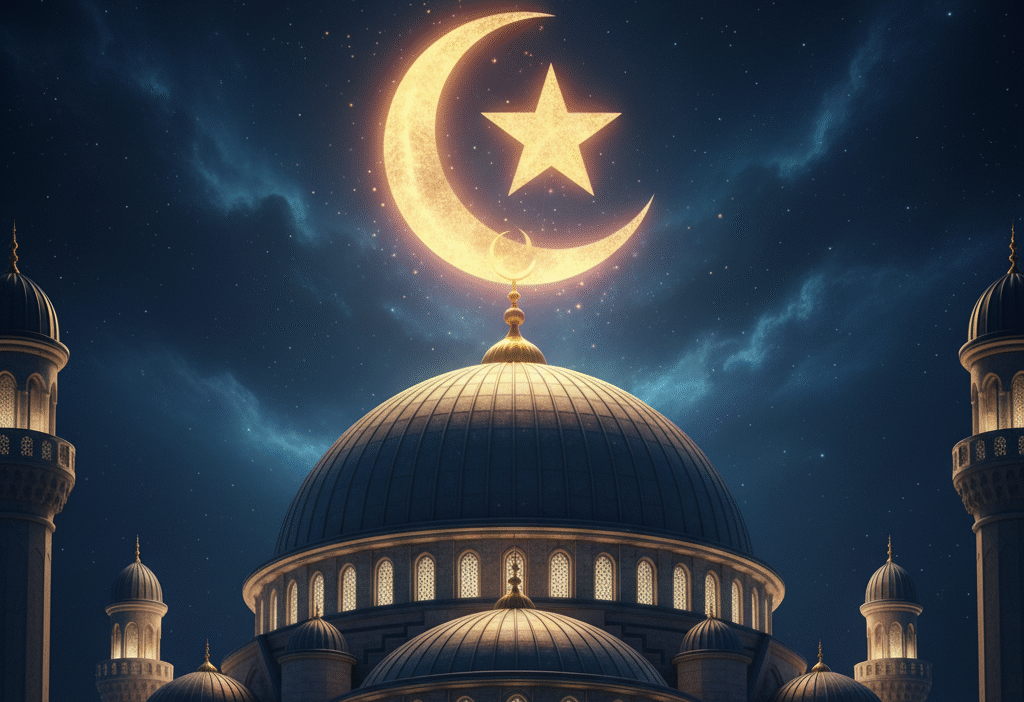
For centuries, the crescent moon and star have shone atop mosques, flags, and artworks — a universal symbol of Islam recognized across the world. But beyond its elegant shape lies a deeper story of faith, time, and transformation.
Did you know the crescent moon is also the basis for the Islamic lunar calendar, guiding over 1.9 billion Muslims in observing Ramadan, Eid, and other sacred events? Or that this celestial duo once appeared in ancient empires long before Islam, only to later find its true spiritual meaning in the Islamic world?
In this article, we’ll uncover how this symbol evolved — from the skies of ancient Mesopotamia to the flags of modern nations — and what it truly represents today: faith, renewal, and divine guidance.
🌙The Origin of the Crescent and Star Symbol
The story of the Islamic crescent and star doesn’t begin with Islam itself.
Historians trace the earliest versions of the crescent symbol back to 6th-century BCE Mesopotamia, where it was associated with Sin, the ancient moon god who symbolized cycles of time and fertility.
Later, in Byzantium (modern-day Istanbul), the crescent became a civic emblem long before the rise of Islam. When the Ottoman Empire conquered Constantinople in 1453, the crescent was adopted into the empire’s flag — gradually merging Islamic identity with this ancient celestial design.
From there, the crescent and star spread widely — from North Africa to Central Asia, becoming a unifying image of Islamic civilization, culture, and community.
⭐ The Crescent and Star in Islamic Faith
In Islam, the crescent moon (Hilal) represents the birth of a new month in the lunar calendar — a symbol of renewal, rebirth, and divine timing.
Each new crescent marks the start of Ramadan, Eid al-Fitr, and Eid al-Adha — reminding believers that life, like the moon, moves in cycles of light, darkness, and return.
The five-pointed star, though not explicitly mentioned in the Qur’an, is often seen as representing the five pillars of Islam:
- Shahada (Faith)
- Salah (Prayer)
- Zakat (Charity)
- Sawm (Fasting)
- Hajj (Pilgrimage)
Together, the crescent and star express the spiritual journey of enlightenment — where light guides the faithful through the darkness, just as the moon and stars guide travelers at night.
🕊️ Symbolism in Art and Architecture
Step into any Islamic city — from Istanbul’s Blue Mosque to Cairo’s Al-Azhar Mosque — and you’ll notice the crescent and star shining atop domes and minarets.
In Islamic art, these forms are never worshipped, but rather used as decorative expressions of faith and divine geometry.
Their circular flow and balance reflect Tawheed — the concept of the oneness of God.
In calligraphy, jewelry, carpets, and tilework, the crescent and star serve as a visual reminder that the heavens and earth are interconnected, and that Allah’s light reaches all corners of the world.
🕌 The Crescent in the Islamic Calendar
The Islamic (Hijri) calendar is based on the cycles of the moon, making the crescent central to Islamic life.
The first sighting of the Hilal marks the beginning of a new month — an event so important that entire committees, even in the age of satellites, still physically sight the moon in many countries.
This act ties modern Muslims to the Prophet Muhammad’s (PBUH) own tradition, who emphasized following lunar signs as a natural, divine rhythm.
Thus, the crescent is not just symbolic — it’s a living calendar, a connection between human action and celestial design.
220+ 🐝 Yellowjackets Sign Meaning 💛 | Hidden Message Explained 2025
🕰️ Historical Evolution: From Empire to Identity
When the Ottoman Empire adopted the crescent and star, it wasn’t just about faith — it became a political emblem of unity.
By the 19th century, as Ottoman influence expanded, the symbol became synonymous with Islam across continents.
After the empire’s fall, many modern nations — Pakistan, Algeria, Turkey, Tunisia, and Malaysia — incorporated the crescent and star into their national flags.
Each adaptation carries unique cultural meanings:
- Turkey’s red flag symbolizes courage and independence.
- Pakistan’s green crescent represents peace and progress.
- Algeria’s half-moon evokes hope and divine protection.
Through each variation, the crescent and star remain timeless emblems of identity and faith.
🌍 Modern Meaning: Beyond Religion
In today’s world, the crescent and star have moved beyond strictly religious contexts.
You can find them in fashion, jewelry, logos, tattoos, and digital art — symbols of spirituality, protection, and balance even among non-Muslims.
On social media, the crescent often appears beside messages of peace, empathy, and Ramadan celebrations, showing how this ancient image continues to unite people across cultures.
Artists use it to represent hope after darkness, while designers employ it as a universal sign of connection between heaven and earth.
The symbol’s modern journey reflects the same message Islam teaches: light always returns — and faith, like the moon, renews endlessly.
🧭 The Crescent and Star in Daily Life
Beyond flags and architecture, the crescent and star appear in daily Muslim life — engraved on mosque gates, Quran covers, jewelry, and home décor.
Wearing or displaying it isn’t an act of worship but a gesture of cultural pride and identity.
It reminds believers of their shared rhythm with the moon and the guidance of Allah’s eternal light.
Even in popular culture, the symbol’s beauty continues to inspire — from the emblems of humanitarian organizations to modern brand designs that seek harmony and balance.
💫 Spiritual Essence: The Light That Never Fades
At its core, the crescent and star symbolize light overcoming darkness — a spiritual metaphor that resonates across religions and philosophies.
It represents growth, awakening, and divine presence — the moon waxing and waning, the stars shining unbroken.
In every night sky, Muslims see not only beauty but reminders of mercy, order, and renewal.
It’s a visual dhikr — a silent remembrance that God’s light guides even in the darkest hours.
🕋 The Crescent and Star Today: A Global Legacy
Today, the crescent and star appear in over 50 national and regional emblems, on countless mosques, and in millions of hearts.
Its message — that faith is both personal and universal — continues to shape how Islam is viewed worldwide.
Even as technology transforms the modern world, the crescent and star remain timeless — a bridge between the past and the present, faith and art, heaven and earth.
🌠 Conclusion: A Symbol That Lives in Every Light
From ancient Mesopotamia to the domes of Mecca, the crescent and star have told one story — of renewal, unity, and divine light.
They connect history to faith, and faith to eternity.
To millions, this emblem means more than religion — it represents hope, rhythm, and the promise that light always returns.
In every corner of the world, when the crescent rises and the star glows, it whispers the same message:
“Guidance is eternal. Faith shines even in darkness.”
💬 FAQs: Islam Symbol Meaning
Q1: Is the crescent and star mentioned in the Qur’an?
No. The Qur’an does not mention any physical symbol, but the crescent is used practically for marking lunar months. Its meaning developed culturally through Islamic history.
Q2: What does the crescent symbolize in Islam?
It represents new beginnings, divine guidance, and the lunar rhythm that determines the Islamic calendar.
Q3: Why is the star important?
The star often stands for the five pillars of Islam and symbolizes divine light leading the faithful.
Q4: When did Muslims start using the crescent symbol?
The symbol gained Islamic association during the Ottoman Empire (14th–15th century) and later became widespread in flags and architecture.
Q5: What does the crescent and star mean in jewelry or tattoos?
In modern culture, it’s seen as a sign of peace, faith, and balance — often worn for beauty or spiritual meaning.
Q6: Why do some non-Muslims use the crescent and star?
Because it represents universal ideas of light, cycles, and harmony, it appeals to people seeking symbols of hope and renewal.

James Thornton is a researcher and writer focused on sleep science, lucid dreaming, and the neurological aspects of dream formation. With a strong academic foundation in cognitive science, James specializes in analyzing how dreams influence memory, creativity, and emotional health. His contributions to DreamingSign.com are well-known for their scientific accuracy and thought-provoking insights, helping readers understand the powerful connection between the brain and the dream world.