
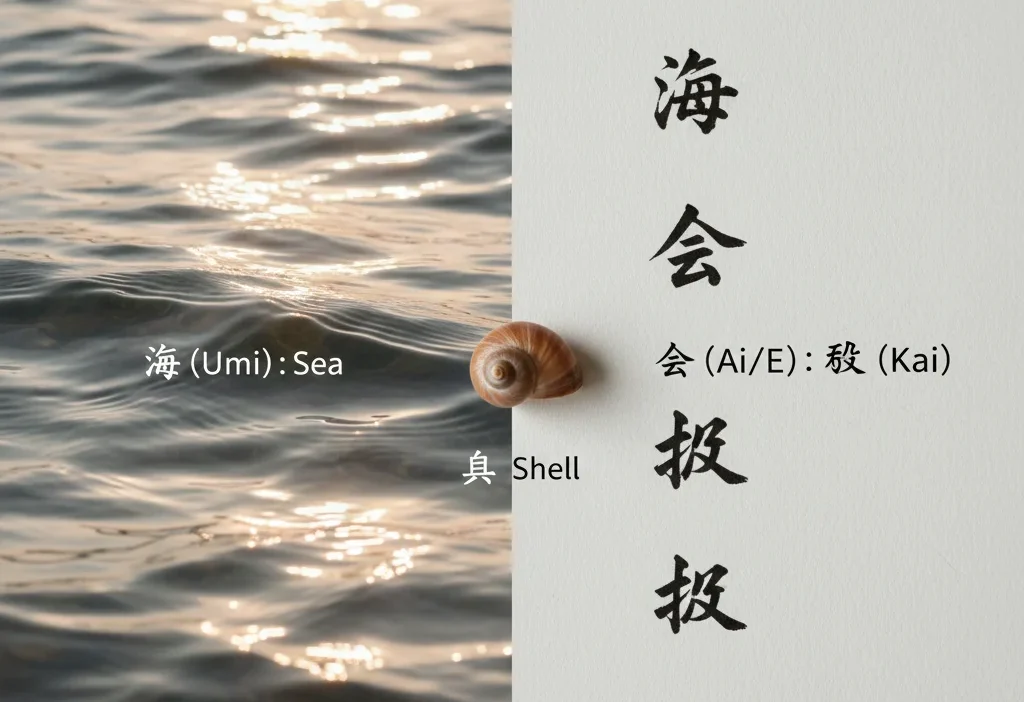
In Japanese, “Kai” (かい, カイ) has multiple meanings depending on the kanji character used. The most common interpretations are “ocean/sea” (海), “shell” (貝), “restoration” (回復), or “meeting/gathering” (会). As a name, it’s gender-neutral and carries a sense of strength and nature.
Imagine you’re binge-watching an anime or scrolling through a list of popular baby names, and you keep seeing the name “Kai.” It’s sleek, modern, and pops up everywhere—from martial arts masters to surfers in manga. But then you see it in a different context, like in the word “kaizen” (改善) for continuous improvement, or hear it shouted in a dojo. You pause, scratch your head, and think, “Wait, what does ‘Kai’ actually mean in Japanese?” If that’s you, you’ve sailed to the right place. Let’s dive deep into the versatile and beautiful world of this tiny but mighty word.
🧠 What Does “Kai” Mean in Japanese?
Unlike English, where words have fairly fixed meanings, Japanese meanings are deeply tied to the kanji characters used to write them. “Kai” is a pronunciation (読み方, yomikata) that can be represented by many different kanji, each with its own meaning. This makes it a homophone—a word that sounds the same but has different meanings.
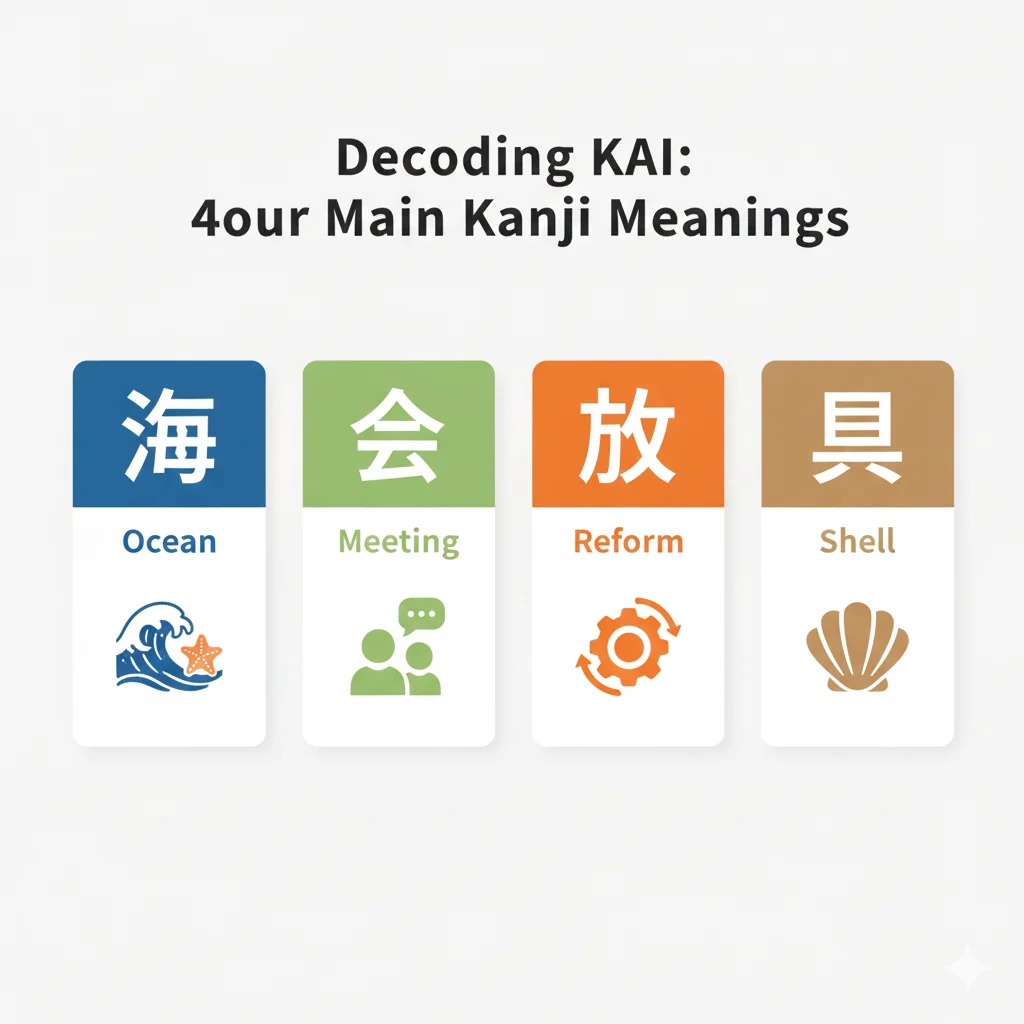
The core meaning of “Kai” isn’t one single thing; it’s a cluster of concepts. At its heart, it often relates to the sea, change, gathering, or healing. Here are the most significant kanji for “Kai”:
- 海 (Kai): This is the most iconic meaning—“ocean” or “sea.” It evokes vastness, power, mystery, and beauty. It’s a hugely popular element in names and poetry.
- 会 (Kai): This means “meeting,” “assembly,” or “gathering.” You see it in words like 会社 (kaisha – company), 会議 (kaigi – meeting), and 宴会 (enkai – party).
- 貝 (Kai): This means “shellfish” or “shell.” It’s a simpler, more literal meaning.
- 改 (Kai): This means “reform” or “renewal.” It’s the “kai” in the famous business philosophy 改善 (kaizen) which means “continuous improvement.”
- 回復 (Kai-fuku): While “kai” here is part of a compound word, it carries the meaning of “recovery” or “restoration.”
In short: Kai = A versatile sound representing ocean, meetings, change, or shells, depending on the kanji used.
What Does Oy Mean? The Shocking Answer Explained
📱 Where Is “Kai” Commonly Used?
The word “Kai” is woven into the fabric of Japanese language and culture. You’ll encounter it in:
- 👶 Personal Names: A top-tier, gender-neutral name for both males and females. Its popularity stems from its strong, positive, and nature-connected meanings.
- 🎌 Anime & Manga: A favorite for character names, often given to powerful, mysterious, or water-related characters (e.g., Kai Shiden from Gundam, Kai from Beyblade, Kaido from One Piece whose name uses a different “kai”).
- 🏯 Business & Culture: In terms like “kaizen” (改善) for improvement, and “enkai” (宴会) for social drinking parties.
- 🥋 Martial Arts: Used as a kiai (気合)—a short, spirited shout to focus energy during a strike or movement. While spelled differently, the pronunciation is identical.
- 🗺️ Place Names: Found in many Japanese place names, like Kaizu (海津) – “sea harbor,” or as part of larger words describing coastal areas.
🧩 The Many Faces of Kai: A Kanji Breakdown
To truly understand “Kai,” you need to meet its most common kanji personalities.
1. 海 (Ocean/Sea)
This is the king of “Kai” meanings. It represents everything about the sea: its calmness, its stormy power, its depth, and its abundance. It’s a symbol of life and endless possibility.
- Example Word: 海洋 (kaiyou) – ocean, marine.
- Name Example: A boy named 海斗 (Kaito) could have kanji meaning “ocean fighter” or “soaring over the sea.”
2. 会 (Meeting/Gathering)
This “Kai” is all about human connection. It’s the coming together of people, ideas, or entities.
- Example Word: 社会 (shakai) – society.
- Name Example: A girl named 美会 (Mikai) could have kanji interpreted as “beautiful gathering.”
3. 改 (Reform/Change)
This “Kai” is about positive transformation and correction. It’s deliberate and improvement-oriented.
- Example Word: 改正 (kaisei) – revision, amendment.
- Context: This is less common as a standalone name but is powerful in concepts like Kaizen (改善).
4. 貝 (Shell)
A more grounded, earthy meaning. It connects to the beach, treasure, and simplicity.
- Example Word: 貝殻 (kaigara) – seashell.
- Name Example: It’s a rarer but possible name choice, often appreciated for its cute and simple imagery.
💬 Examples of “Kai” in Real Contexts
Let’s see how “Kai” flows naturally in conversation and text.
Example 1: As a Name
A: “Have you met the new transfer student?”
B: “Yeah, Kai! They’re really good at surfing. Fits their name, since it means ‘ocean’ 🌊.”
Example 2: In a Business Context
Manager: “Our focus this quarter is on kaizen. Look for small processes we can improve daily.”
Example 3: Planning a Social Event
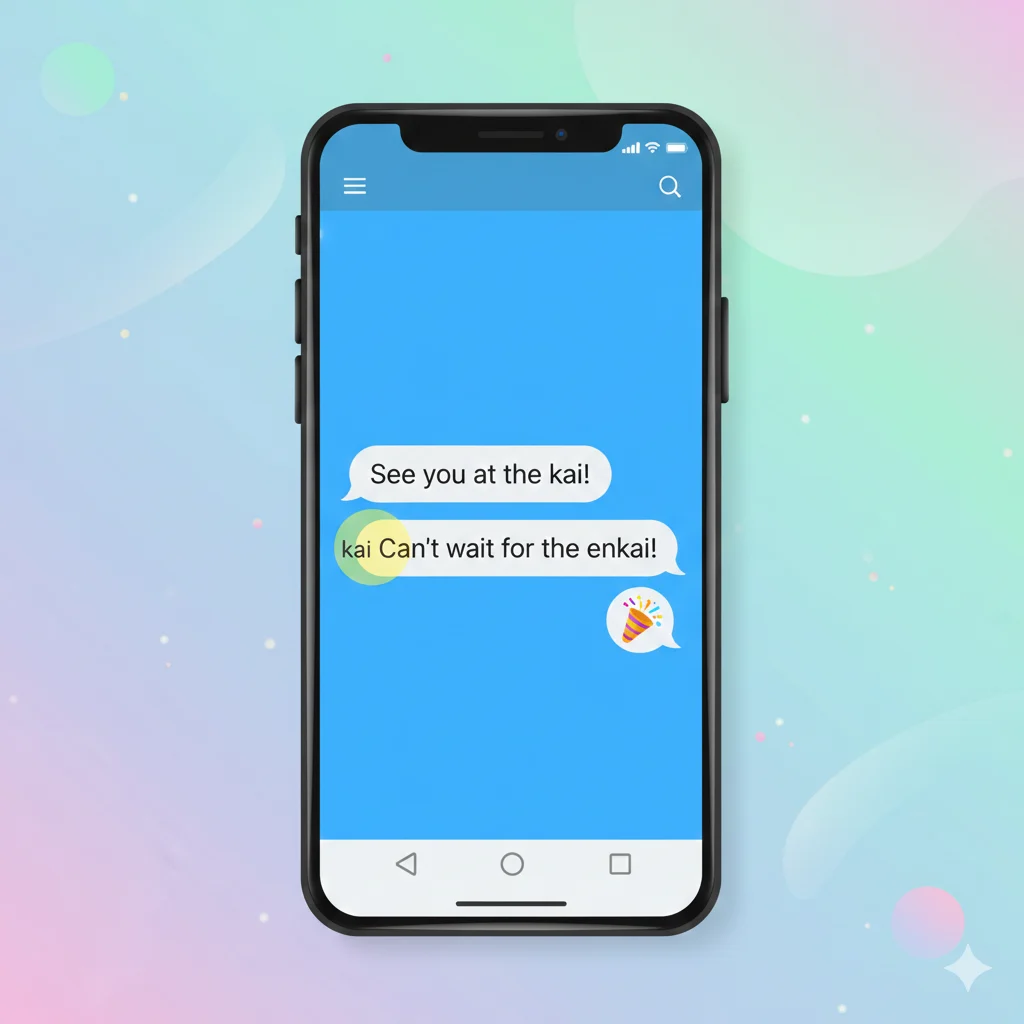
A: “会社の忘年会はいつ?” (Kaisha no bounenkai wa itsu? – When’s the company year-end party?)
B: “来週の金曜日だよ!” (Raishuu no kinyoubi da yo! – It’s next Friday!)
Example 4: In Martial Arts
Sensei: “More power! Don’t forget your kiai when you strike! えいやっ!”
Example 5: Describing Recovery
A: “調子はどう?” (Choushi wa dou? – How are you feeling?)
B: “少しずつ回復してるよ。” (Sukoshizutsu kaifuku shiteru yo. – I’m recovering little by little.)
🕓 When to Use and When Not to Use “Kai”
✅ When It’s Perfect:
- Naming a Child: A beautiful, meaningful, and internationally friendly choice.
- Discussing Japanese Culture: Accurately explaining the concept of kaizen or what an enkai is.
- Talking About Anime/Manga: Correctly understanding a character’s name or a shouted “kiai!”
- Writing Poetry or Creative Work: Using the oceanic (海) imagery for metaphor.
❌ When to Avoid or Be Specific:
- Assuming One Meaning: Always remember context is king. The “Kai” in a boardroom is different from the “Kai” at the beach.
- In Formal Legal Documents: If you’re translating, you must use the correct kanji to avoid ambiguity. The pronunciation alone is not enough.
- Casually Using “Kiai”: Unless you’re actually in a dojo or making a joke, shouting “Kiai!” might get you strange looks.
Contextual Usage Table:
| Context | Example Phrase (Romaji/English) | Why It Works |
|---|---|---|
| Naming | “We named our son Kai (海).” | Evokes strength, nature, and beauty. |
| Business Practice | “We adopted kaizen (改善) principles.” | Correctly identifies the philosophy of improvement. |
| Social Event | “Let’s go to the enkai (宴会)!” | Properly refers to a Japanese-style party. |
| Casual Chat | “Kai’s name is written with the ocean kanji.” | Shows nuanced understanding of the language. |
🔄 Similar Japanese Name & Word Concepts
If you like the vibe of “Kai,” you might also resonate with these related terms.
| Slang/Name | Meaning | When to Use / Vibe |
|---|---|---|
| Ren (蓮) | Lotus flower | A popular, graceful name symbolizing purity and rebirth. |
| Haru (春/陽) | Spring / Sunshine | A warm, positive name associated with new beginnings and light. |
| Sora (空) | Sky | Like Kai (海), it’s a big, natural element. Evokes openness and freedom. |
| Kaito (海斗) | Sea + [Fighting/Soaring] | A very popular male name extension of Kai (海). |
| Umiumi (海海) | Sea-Sea (repetition) | A modern, trendy, and cute compound name using the “umi” reading of 海. |
| Minato (港) | Harbor | Shares the nautical theme but implies safety, connection, and a starting point. |
❓ FAQs About “Kai” in Japanese
Is Kai a boy’s or girl’s name in Japan?
It’s completely gender-neutral. The perception often depends on the kanji used and individual preference. For example, 海 (ocean) is common for boys, but can be used for anyone.
What is the most popular meaning of Kai?
In modern contexts, especially internationally, the ocean meaning (海) is the most popular and instantly recognized.
How do I know which “Kai” someone means?
You must see the kanji or understand the context. In conversation, if it’s unclear, you might ask, “どの漢字ですか?” (Dono kanji desu ka? – Which kanji is it?).
Is “Kai” related to the Hawaiian or Maori word “Kai” (meaning sea/food)?
It’s a fascinating coincidence! The Japanese 海 (kai – sea) and the Polynesian languages’ “kai” (meaning sea or food) are not linguistically related, but share a similar sound and meaning—a perfect example of convergent evolution in language.
Can “Kai” be a full name on its own?
Yes, absolutely. A single-kanji name like 海 (Kai) is short, stylish, and powerful.
🎌 Conclusion
So, what does Kai mean in Japanese? It’s not a single definition to memorize, but a key to a rich tapestry of meanings. It’s the crash of ocean waves (海), the energy of a gathering (会), the discipline of self-improvement (改), and the focus of a warrior’s spirit (気合). Whether you’re considering it for a name, encountered it in your favorite show, or are simply fascinated by language, understanding “Kai” offers a beautiful glimpse into how Japanese culture finds depth and poetry in a single syllable. Next time you see “Kai,” you’ll know there’s a whole world—or perhaps a whole sea—behind it.

Olivia Bennett is a lifestyle researcher and holistic wellness advocate specializing in mindfulness, dream healing, and manifestation techniques. With a background in psychology and meditation therapy, Olivia writes to empower readers to achieve mental clarity and emotional balance through dream awareness. Her articles provide practical tips, spiritual insights, and real-life strategies for boosting intuition and creating a more meaningful life. Olivia’s work at DreamingSign.com inspires readers to use dreams as a tool for personal transformation.