
Imagine scrolling through a friend’s college acceptance post. “So excited to study the liberal arts at XYZ University!” they write. You hit the ‘like’ button, but a tiny question pops into your head: “Wait… what does that actually mean? Is it just painting and reading old books?” If you’ve ever felt a flicker of confusion about this classic academic term, you’re not alone. The phrase “liberal arts” is everywhere—from university brochures to career advice columns—yet its true meaning often gets lost in a cloud of assumptions. Let’s clear the air and discover what a liberal arts education really is, why it’s more relevant than ever, and how it definitely isn’t a secret Gen-Z texting code.
In an academic context, “liberal arts” refers to a broad-based education designed to cultivate general intellectual abilities—like critical thinking, communication, and problem-solving—rather than specific vocational skills. It encompasses subjects in the humanities, social sciences, natural sciences, and arts.
🧠 What Does “Liberal Arts” Actually Mean?
Let’s break down the term itself. “Liberal” here comes from the Latin liberalis, meaning “worthy of a free person.” In ancient Greece and Rome, the liberal arts were the areas of knowledge considered essential for an active, informed citizen to participate in civic life. They were the opposite of “servile arts,” which were manual or vocational skills.
Today, the liberal arts represent a curriculum aimed at developing a well-rounded individual with a versatile mind. It’s less about what you know and more about how you think, learn, and adapt. Core components include:
- Humanities: Literature, philosophy, history, languages.
- Social Sciences: Sociology, psychology, political science, economics.
- Natural Sciences: Biology, chemistry, physics, astronomy.
- Formal Sciences: Mathematics, logic.
- Arts: Visual arts, music, theater.
Example in context: “She chose a liberal arts college because she wanted to explore philosophy, environmental science, and creative writing before declaring a major.”
In short: Liberal Arts = Broad, foundational education in multiple disciplines = Learning how to think, communicate, and solve complex problems.
📚 Where Did the Liberal Arts Come From?
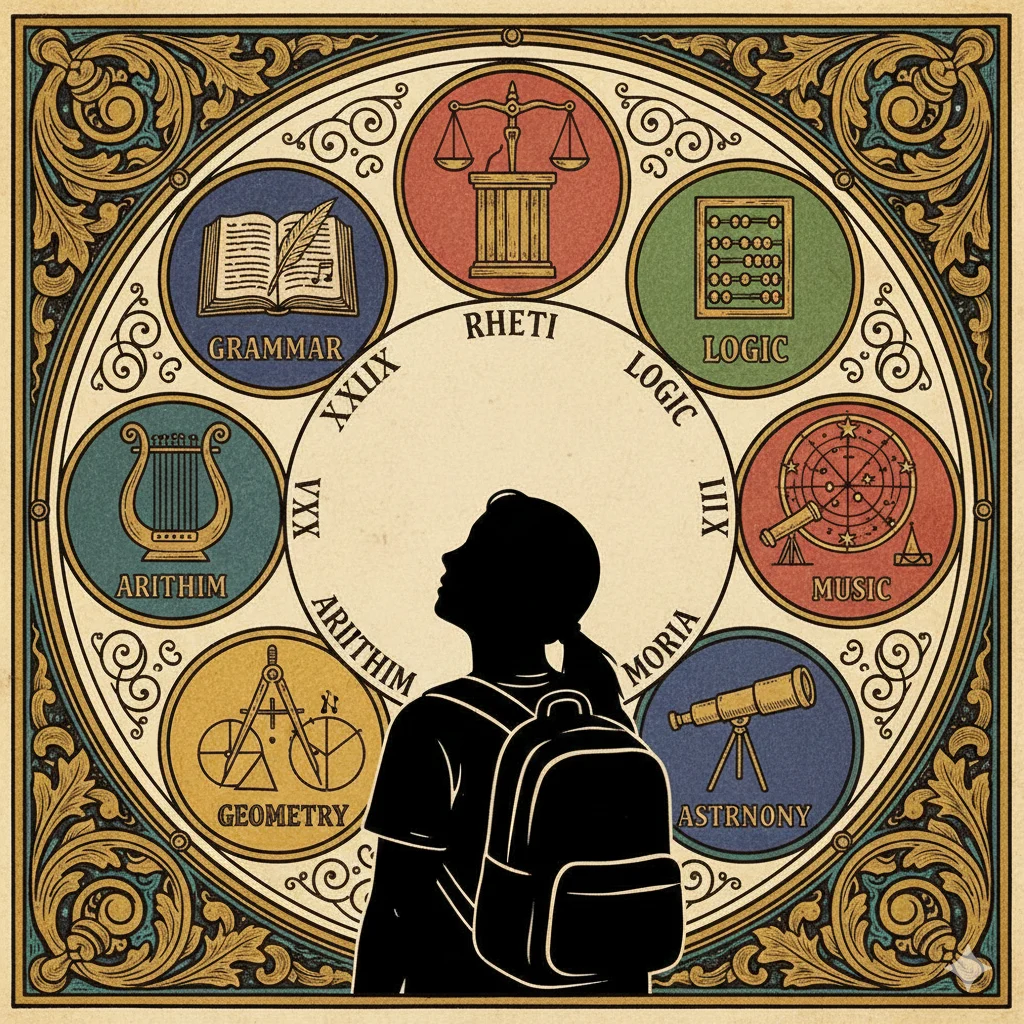
Understanding the history helps explain its lasting power. The modern concept stems from the Medieval Trivium and Quadrivium:
- The Trivium (The “Three Ways” of Language):
- Grammar: The structure of language.
- Logic: The structure of rational thought.
- Rhetoric: The art of persuasive communication.
- The Quadrivium (The “Four Ways” of Number):
- Arithmetic: Number in itself.
- Geometry: Number in space.
- Music: Number in time.
- Astronomy: Number in space and time.
This framework was meant to equip a person for any intellectual challenge. The modern liberal arts degree is the descendant of this ideal, expanding the subjects but keeping the core mission: to liberate the mind through foundational knowledge.
🎓 Modern Liberal Arts Majors and Careers
A major misconception is that liberal arts leads nowhere. The opposite is true. It leads everywhere, just not to a single, narrow job title at graduation. It builds adaptable skills highly valued in today’s fast-changing job market.
Popular Liberal Arts Majors: Political Science, English, Psychology, History, Sociology, Environmental Studies, Communications, International Relations.
Top Skills Gained (The “Portable Skills”):
- ✅ Critical & Analytical Thinking
- ✅ Clear Written & Verbal Communication
- ✅ Research & Information Synthesis
- ✅ Ethical Reasoning & Cultural Awareness
- ✅ Creative Problem-Solving
Real Career Paths: Graduates become marketing managers, data analysts (with added training), lawyers, UX designers, editors, policy advisors, nonprofit directors, and entrepreneurs. Their strength isn’t in specific technical knowledge from day one, but in their ability to learn quickly, analyze situations, and communicate effectively—skills that become more valuable over a long career.
💬 Liberal Arts in Modern Conversation: Examples
While not texting slang, the term comes up in real discussions about education and careers.
Example 1: The College Decision
A: I’m struggling to pick between the engineering school and the liberal arts college.
B: Think about how you learn best! Do you want depth in one field from the start, or a couple years to explore and then focus? The liberal arts path is great for figuring it out.
Example 2: Defending the Degree
A: My parents keep asking what you can do with a history degree.
B: Tell them it’s a classic liberal arts degree. You’re learning to research, write, and argue from evidence—skills every company needs. You’re not just learning dates!
Example 3: On a Resume/LinkedIn
Profile Headline: “Communications Director | Leveraging a liberal arts background in critical thinking to develop impactful brand narratives.”

✅ When to Use and When Not to Use the Term “Liberal Arts”
✅ When to Use It:
- When discussing broad college education paths and philosophies.
- When highlighting transferable skills like writing or critical thinking on a resume or in an interview.
- In debates about the value of higher education and workforce preparation.
- When exploring interdisciplinary fields that don’t fit a narrow technical box.
❌ When Not to Use It:
- As a synonym for “unemployable” or “impractical.” (It’s a harmful stereotype!)
- When you specifically mean “fine arts” (like painting or sculpture). Liberal arts includes the arts but is much broader.
- In casual texting as slang—your friends will just be confused!
| Context | Example Phrase | Why It Works |
|---|---|---|
| College Counseling | “I’m leaning toward a liberal arts approach to fulfill my gen-eds before I specialize.” | Correctly describes an educational model. |
| Job Interview | “My liberal arts training taught me how to quickly research and synthesize new information.” | Highlights adaptable core competencies. |
| Misused Example | “He’s a painter, so he’s into the liberal arts, I guess.” | Incorrectly limits the term. Fine arts is one subset. |
🔄 Related Educational Terms and Alternatives
| Term | Meaning | Key Difference |
|---|---|---|
| Humanities | Studies of human culture (history, art, language, philosophy). | A subset of the liberal arts. Liberal arts also includes sciences. |
| STEM | Science, Technology, Engineering, and Mathematics. | Often contrasted with liberal arts, but sciences are part of liberal arts! STEM is more narrowly technical. |
| Vocational Training | Education focused on a specific trade or skill (e.g., welding, coding bootcamp). | Teaches how to do a specific job. Liberal arts teaches how to think and adapt for many paths. |
| General Education | Broad coursework required in early college years. | The “core curriculum” that embodies the liberal arts ideal within any degree program. |
| Interdisciplinary Studies | A major that combines multiple fields (e.g., Cognitive Science). | A modern expression of the liberal arts spirit, breaking down walls between subjects. |
❓ FAQs About Liberal Arts
Q: Is a liberal arts degree useless for finding a job?
A: No. While the first job might require some extra networking or skill-building, liberal arts graduates excel in the long term. Their skills in leadership, communication, and problem-solving are crucial for management and strategic roles. Many employers actively seek these “soft skills.”
Q: What’s the difference between a “liberal arts college” and a “university”?
A: A liberal arts college typically focuses on undergraduate education with small classes, broad curricula, and an emphasis on teaching. A university is usually larger, contains multiple graduate schools and colleges (including a liberal arts college), and may place more emphasis on research.
Q: Can you be pre-med or pre-law in liberal arts?
A: Absolutely. Many successful doctors and lawyers are liberal arts graduates. Pre-med students often major in a science like Biology (a liberal arts science) while also taking required courses. Pre-law students often major in Philosophy, History, or Political Science to hone the reading, writing, and reasoning skills vital for law school.
✨ Conclusion
So, the next time you hear “liberal arts,” think beyond the dusty stereotypes. It isn’t a texting fad or an outdated idea. It’s a dynamic, time-tested approach to education that builds the most durable tools you can have: a nimble mind, a persuasive voice, and the intellectual curiosity to navigate an unpredictable world. Whether you’re exploring majors, advising a student, or simply satisfying your own curiosity, remember that the liberal arts aren’t about filling your head with facts. They’re about freeing your mind with understanding. And in a world of rapid change, that’s a superpower that never goes out of style.

Sophia Hayes is an expert in dream psychology and subconscious symbolism with over 10 years of experience in spiritual research and metaphysical sciences. Her passion lies in helping readers unlock the hidden messages within their dreams to improve emotional healing and personal growth. Through her deep understanding of spiritual symbolism, Sophia provides insightful, research-based interpretations that bridge science and spirituality. At DreamingSign.com, she shares transformative guidance to help individuals understand their dreams and connect with their higher selves.