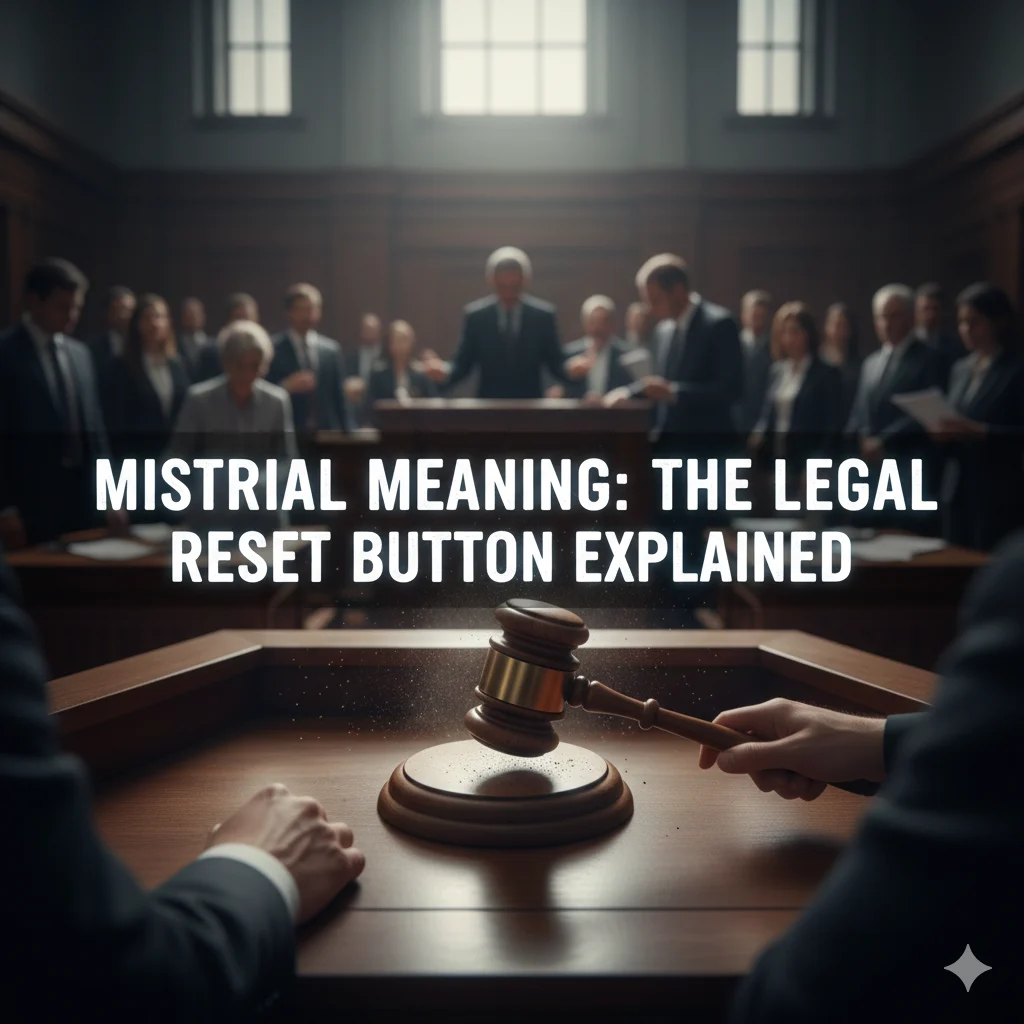
In legal contexts, a mistrial means a trial that is terminated and declared invalid before reaching a verdict, typically due to a significant procedural error or misconduct that compromises fairness. It’s essentially a courtroom “do-over.”
You’re binge-watching a tense courtroom drama. The prosecutor pulls a shady move, the defense lawyer shouts “Objection!” The judge bangs the gavel and solemnly declares, “I am declaring a mistrial.” The scene cuts to commercial, and you’re left wondering—what just happened? Did someone win? Is the accused free? Does everything start over?
If you’ve found yourself Googling what does mistrial mean after a TV cliffhanger or a news headline, you’re not alone. While it’s not “text slang” in the traditional sense, the term “mistrial” has bled into everyday conversation, online discussions, and memes, often used metaphorically to describe any situation that’s hopelessly derailed. Let’s unpack this dramatic legal term, so you never have to face a cliffhanger of confusion again.
🧠 What Does “Mistrial” Mean? Breaking Down the Legal Jargon
In its purest legal sense, a mistrial is a trial that is terminated and declared void before its normal conclusion. This means the jury is dismissed, no verdict (guilty or not guilty) is reached, and the case does not end with that particular trial. It’s a nullity—like hitting a giant “reset” button on that court proceeding.
A judge declares a mistrial when a fundamental error occurs that is so prejudicial that continuing the trial would be unfair, and the error cannot be adequately fixed with a simple instruction to the jury. The goal is to preserve the constitutional right to a fair trial.
In short: Mistrial = Invalid Trial = Judicial Do-Over.
Common Reasons for a Mistrial:
- Jury Misconduct: Jurors conducting independent research, discussing the case improperly, or being influenced by outside information.
- Prejudicial Statements: A lawyer or witness makes a statement so inflammatory (like mentioning a defendant’s prior convictions improperly) that it poisons the jury pool.
- Hung Jury: The jury is irreconcilably deadlocked and cannot reach a unanimous verdict (in most criminal cases) or the required majority.
- Procedural Error: A significant mistake in how evidence was presented or how the trial was conducted.
- Attorney or Judge Misconduct: Serious unprofessional behavior that undermines the trial’s integrity.
📜 Where Is “Mistrial” Commonly Used? From Courtroom to Comments
While its home is the courtroom, the term “mistrial” has escaped into wider culture. You’ll encounter it in:
- 📺 TV & Film Discussions: In comment sections for shows like Law & Order, Suits, or How to Get Away with Murder.
- 🗞️ News & Current Events: Headlines and analysis pieces about high-profile legal cases.
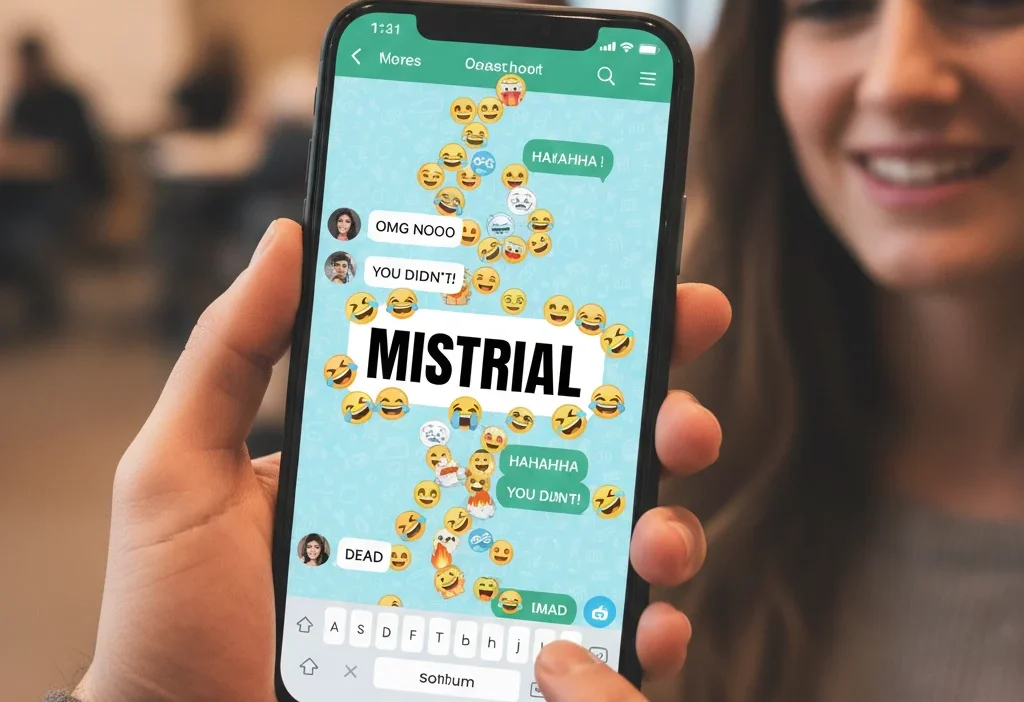
- 💬 Social Media & Memes: Used metaphorically to describe any situation that has completely fallen apart. (e.g., “My team’s project meeting was a total mistrial.”).
- 🎮 Gaming & Streaming: When a planned match or event is canceled due to a rule break or glitch.
- 📚 Online Forums (Reddit, Quora): Where people explain legal concepts or debate courtroom drama plot points.
Tone: It is a formal legal term. When used in casual settings, it’s almost always metaphorical and humorous, signaling a dramatic failure or reset.
💬 Examples of “Mistrial” in Conversation
Let’s see how it’s used, both literally and in its slangy, metaphorical form.
Real Legal Context:
Prosecutor: (To the jury) “And the defendant has a long history of violence—”
Defense Attorney: “OBJECTION, Your Honor! That is highly prejudicial and inadmissible!”
Judge: “Sustained. Jurors, you will disregard that statement. … Counsel, approach the bench. This is a serious violation. I see no alternative. I am declaring a mistrial.“
In Online TV Discussions:
A: OMG, did you see the finale? The evidence was tampered with!
B: I know! I was screaming at my TV. Of course it ended in a mistrial. Season 2 here we come.
Metaphorical / Slang Use in a Group Chat:
A: So how did the big family dinner go with your new partner?
B: 😬 Uncle Joe got into politics, mom spilled wine on the white rug, and the dog ate the main course. It was a complete mistrial. We’re never doing that again.
In Gaming:
Player 1: “Hey, why was the tournament stream stopped?”
Player 2: “Someone found a major exploit. Admins called a mistrial while they figure it out.”
In Work Chat (Metaphorical):
Colleague 1: “Ready to present the Q3 plan to the bosses?”
Colleague 2: “The projector died, our lead analyst is sick, and the files are corrupted. Requesting a mistrial until next week.”
🕓 When to Use and When Not to Use “Mistrial”
✅ When to Use “Mistrial”:
- When discussing an actual, terminated legal proceeding.
- In metaphorical, casual conversation to humorously describe a situation that has utterly failed or been canceled.
- In online discussions about TV plots, legal news, or sports/gaming events canceled due to rule-breaking.
❌ When NOT to Use “Mistrial”:
- To describe a simple delay or minor mistake. (Use “setback” or “delay”).
- In formal writing, unless you are discussing law.
- To describe a situation with a clear “loser” or “winner.” A mistrial means there is no result.
- As a synonym for “appeal” or “overturned verdict.” Those happen after a verdict.
Context & Phrase Comparison Table
| Context | Example Phrase | Why It Works / Doesn’t |
|---|---|---|
| Legal Report | “The judge declared a mistrial due to jury tampering.” | Formally Correct. The precise legal term. |
| Casual Friend Chat | “Our attempt to bake a soufflé was a mistrial. We ordered pizza.” | Metaphorically Funny. Clearly hyperbolic and informal. |
| Work Email | “Due to the data outage, we should reschedule the launch review.” | Professional. “Mistrial” would be unprofessional and confusing here. |
| Sports Commentary | “The match was called a no-contest after the pitch invasion.” | Sport-Specific. “No-contest” or “canceled” is the correct term here. |
🔄 Similar Legal & Metaphorical Slang Words
| Slang / Term | Meaning | When to Use (Casual/Metaphorical Context) |
|---|---|---|
| Hung Jury | A jury that cannot agree on a verdict. | To describe a group (friends, coworkers) totally deadlocked on a decision. “Where to eat? We’re a hung jury.” |
| Case Dismissed | A judge throws the case out before trial. | To abruptly end an argument or conversation you’re winning. “You have no proof? Case dismissed.” |
| Objection! | A formal protest to evidence or procedure. | To playfully protest a friend’s bad idea or statement. |
| Fifth Amendment | The right against self-incrimination. | To joke about not answering a question. “I plead the Fifth on who ate the last cookie.” |
| Circumstantial Evidence | Indirect evidence that requires inference. | To describe weak proof for a claim. “Your ‘case’ for being late is purely circumstantial.” |
| Appeal | To request a higher court review a decision. | To ask for a re-do or second chance on a decision. “I appeal the group’s movie choice!” |
⚖️ What Happens After a Mistrial? The “What’s Next?”
This is a key follow-up question. A mistrial is not the end of the road. The prosecution usually has the option to:
- Retry the Case: Start the trial over from the beginning with a new jury. This is common.
- Drop the Charges: Decide not to pursue the case further.
- Plea Deal: Negotiate a plea agreement with the defense to avoid a second trial.
The possibility of “double jeopardy” (being tried twice for the same crime) does not apply here because the first trial didn’t reach a valid verdict.
❓ FAQs About “Mistrial”
Is a mistrial a win for the defendant?
Not exactly. It’s a temporary reprieve. It avoids a guilty verdict at that moment, but the defendant is not acquitted (found not guilty). They may still face a retrial.
Can a mistrial be appealed?
Yes, often by the prosecution if they believe the judge was wrong to declare it. The defense can also appeal if they wanted the trial to continue (hoping for an acquittal).
What’s the difference between a mistrial and an overturned verdict?
A mistrial stops a trial before a verdict. An overturned verdict happens after a trial concludes and a higher court reverses the decision on appeal.
Does the jury get in trouble if there’s a mistrial?
Generally, no, unless they engaged in deliberate misconduct (like bribes or ignoring explicit instructions).
How common are mistrials?
They are relatively rare, as judges use them as a last resort to ensure fairness.
🎬 Conclusion
So, what does mistrial mean? It’s the legal system’s emergency stop button—a mechanism to ensure fairness when a trial goes off the rails. While it carries the weight of serious legal consequences in reality, its journey into our everyday slang highlights how courtroom drama captivates us. The next time you hear it, whether in a news report or a friend describing a disastrous dinner party, you’ll know it signals a fundamental reset. The gavel comes down, the slate is wiped (mostly) clean, and the complex drama of justice—or just everyday life—gets a chance to start over.

Olivia Bennett is a lifestyle researcher and holistic wellness advocate specializing in mindfulness, dream healing, and manifestation techniques. With a background in psychology and meditation therapy, Olivia writes to empower readers to achieve mental clarity and emotional balance through dream awareness. Her articles provide practical tips, spiritual insights, and real-life strategies for boosting intuition and creating a more meaningful life. Olivia’s work at DreamingSign.com inspires readers to use dreams as a tool for personal transformation.