Understanding quiet comparative and superlative forms is a core part of English grammar. Learners often ask questions like “Which is correct: quieter or more quiet?”, “Is it quietest or most quiet?”, or “What is the superlative degree of quiet” These confusions happen because English adjectives follow different comparison rules depending on their length and usage.
This guide explains quiet comparative and superlative degree in a clear, modern, and practical way. You will learn correct forms, sentence usage, common mistakes, comparisons with other adjectives like noisy, narrow, and modern, and practice through exercises
Everything is written according to 2026 grammar standards, making this article useful for students, teachers, ESL learners, and exam preparation.
📌 Quick Rule Box
Quick Rule:
One-syllable adjectives like quiet form comparisons using -er / -est.
✔ quiet → quieter → quietest
❌ more quiet / most quiet (not preferred)
What Is the Comparative and Superlative of Quiet?
The adjective quiet describes low sound or calmness. It is a one-syllable adjective, so it follows standard comparison rules.
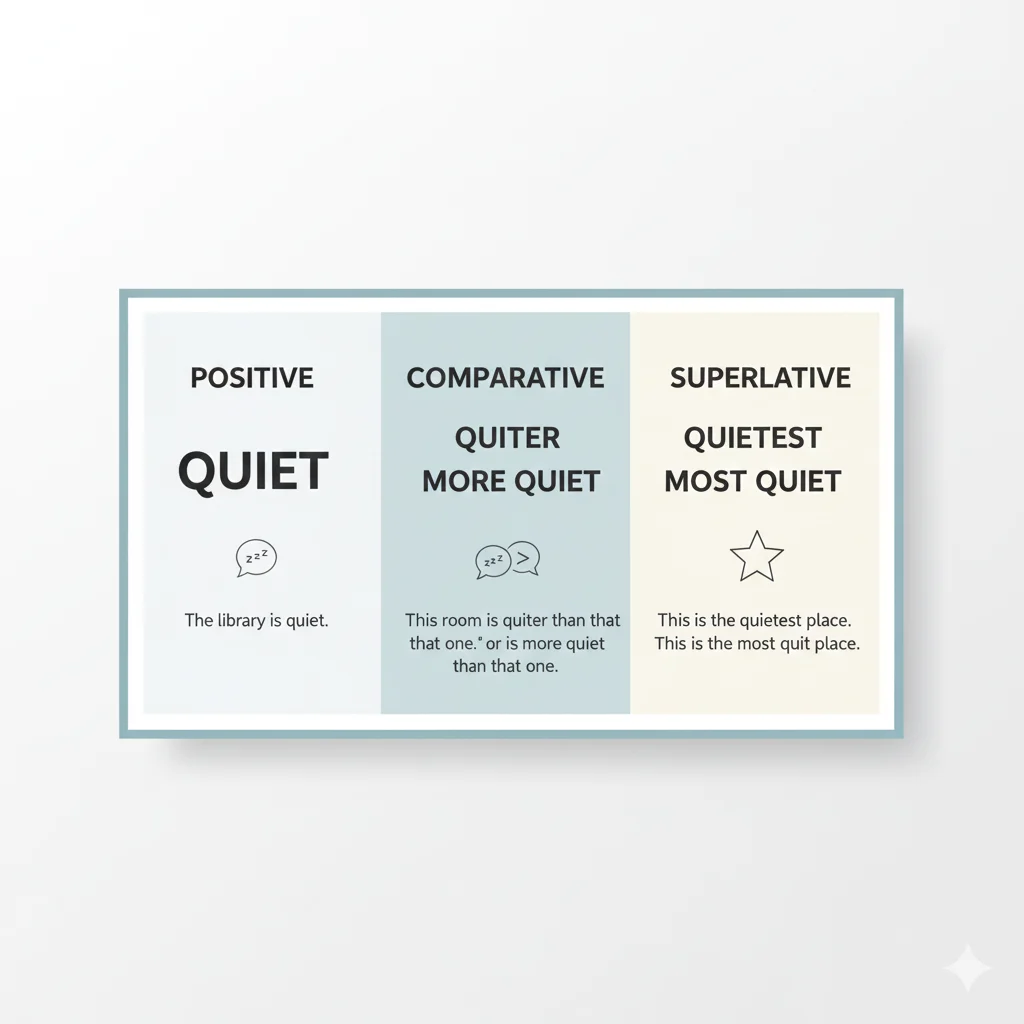
Quiet Comparative and Superlative Form
| Degree | Form |
|---|---|
| Positive | quiet |
| Comparative | quieter |
| Superlative | quietest |
✔ These are the correct and most natural forms used in modern English.
Which Is Correct: Quieter or More Quiet?
This is one of the most common grammar questions.
✅ Correct Form: Quieter
⚠️ Grammatically Possible but Unnatural: More quiet
Explanation
Since quiet has one syllable, English grammar prefers adding -er instead of using “more.” Native speakers almost always say quieter.
Examples
- This room is quieter than the hallway. ✅
- This room is more quiet than the hallway. ⚠️ (awkward)
Conclusion:
✔ Use quieter in speaking, writing, and exams.
Is It Quietest or Most Quiet?
Another frequent confusion.
✅ Correct: Quietest
⚠️ Rare / Old-style: Most quiet
Why Quietest Is Better
The superlative degree of quiet follows the -est rule because it is a short adjective.
Examples
- This library is the quietest place on campus. ✅
- This library is the most quiet place on campus. ⚠️

Superlative Degree of Quiet Explained
The superlative degree of quiet is used when comparing three or more things.
Structure
the + quietest
Examples
- She is the quietest student in the class.
- Early morning is the quietest time to study.
- This village is the quietest area in the region.
Quiet Comparative and Superlative Degree (Full Explanation)
| Degree | Purpose | Example |
|---|---|---|
| Positive | Describe one thing | The room is quiet |
| Comparative | Compare two things | This room is quieter |
| Superlative | Compare many things | This is the quietest |
Understanding these degrees helps avoid incorrect double comparisons.
Quiet Comparative and Superlative Adjectives
Quiet works as a descriptive adjective and follows normal comparison rules.
Correct Forms
- quiet → quieter → quietest
Incorrect Forms to Avoid
- ❌ more quieter
- ❌ most quietest
- ❌ quiet → most quieter
Quiet Comparative and Superlative Sentences
Comparative Sentences
- This street is quieter at night.
- Today feels quieter than yesterday.
- The classroom is quieter after lunch.
Superlative Sentences
- The library is the quietest place in the building.
- She has the quietest voice in the group.
- Midnight is the quietest time of day.
Quiet Comparative and Superlative Examples
Home
- The bedroom is quieter than the living room.
- The study room is the quietest space in the house.
School
- The library is quieter than the cafeteria.
- Exam hall A is the quietest area in school.
Nature
- The forest is quieter than the city.
- Dawn is the quietest time in the countryside.
What Is Quieter Than Quiet?
The phrase “quieter than quiet” is often used for emphasis.
Examples
- The room became quieter than quiet, almost silent.
- Her voice dropped to something quieter than quiet.
✔ Common in creative and descriptive writing
✔ Grammatically correct
Quietest or Most Quiet – Final Comparison
| Form | Recommendation |
|---|---|
| quietest | ✅ Best |
| most quiet | ⚠️ Avoid |
| quieter | ✅ Correct |
| more quiet | ⚠️ Not natural |
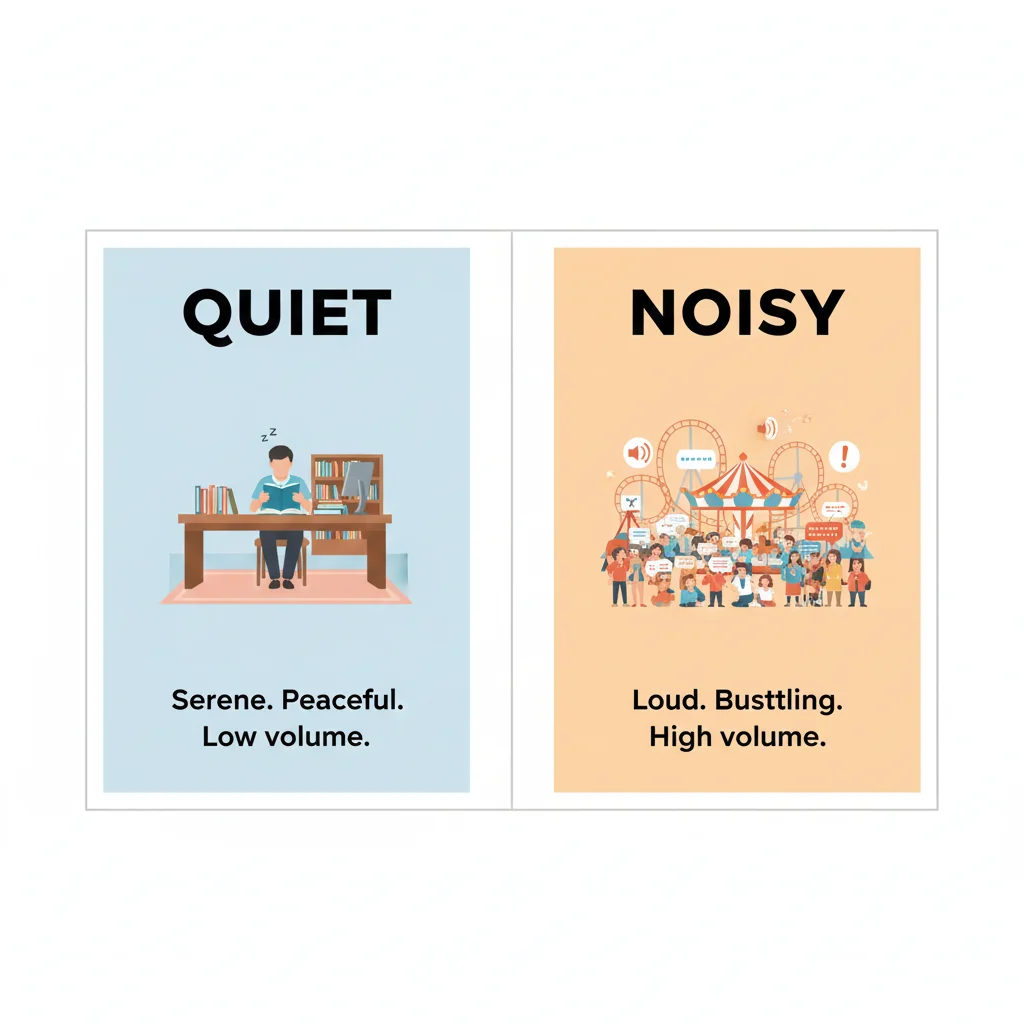
Noisy Comparative and Superlative
Forms
| Degree | Form |
|---|---|
| Positive | noisy |
| Comparative | noisier |
| Superlative | noisiest |
Examples
- The market is noisier in the evening.
- Festivals are the noisiest events here.
Narrow Comparative and Superlative
| Degree | Form |
|---|---|
| narrow | narrower |
| narrowest |
Example
- This road is narrower than that one.
- This is the narrowest street in town.
Modern Comparative and Superlative Usage
Modern English strongly favors:
- -er / -est for short adjectives
- more / most for long adjectives
Rule in Practice
✔ quiet → quieter → quietest
✖ quiet → more quiet → most quiet
Quiet Comparative and Superlative Exercises
Exercise 1: Fill in the Blanks
- This room is ______ than the kitchen.
- That village is the ______ place nearby.
Answers:
- quieter
- quietest
Exercise 2: Choose the Correct Option
- This park is (quieter / more quiet).
- Night is the (quietest / most quiet) time.
Correct:
- quieter
- quietest
Exercise 3: Sentence Correction
❌ This place is more quiet than before.
✅ This place is quieter than before
FAQs
1. What is the comparative of quiet?
Quieter.
2. What is the superlative of quiet?
Quietest.
3. Is “more quiet” wrong?
Not wrong, but not preferred.
4. Is quietest better than most quiet?
Yes, always.
5. Is quiet a comparative adjective?
No, it becomes comparative as quieter.
Conclusion
The correct quiet comparative and superlative forms are quiet, quieter, and quietest. These follow standard rules for one-syllable adjectives and are strongly preferred in modern English. While forms like more quiet or most quiet may appear occasionally, they sound unnatural and should be avoided in exams, writing, and professional communication.
By practicing quiet comparative and superlative sentences, studying real-life examples, and completing exercises, learners can confidently use these forms in everyday English. Mastery of comparisons with adjectives like noisy, narrow, and modern further strengthens grammar accuracy.

James Thornton is a researcher and writer focused on sleep science, lucid dreaming, and the neurological aspects of dream formation. With a strong academic foundation in cognitive science, James specializes in analyzing how dreams influence memory, creativity, and emotional health. His contributions to DreamingSign.com are well-known for their scientific accuracy and thought-provoking insights, helping readers understand the powerful connection between the brain and the dream world.