
Picture this: You’re scrolling through your group chat when your friend shares a truly ridiculous news headline. “Did you see this?” they write. You immediately type back “smh” and hit send. A minute later, another friend replies, “Wait… what does ‘smh’ mean dirty? 😏” Suddenly, the chat derails. You’re left blinking at your screen, wondering if you’ve been accidentally sending the wrong signal this whole time.
If this sounds familiar, you’re not alone. The innocent acronym SMH has found itself tangled in internet rumors, with some searching for a hidden, “dirty” meaning. Let’s clear the air right now. 99.9% of the time, SMH is exactly what it seems: a digital eye-roll. But why the confusion? Let’s dive into the real story of SMH—what it means, how to use it, and why the “dirty” myth persists.
SMH means “Shaking My Head.” It’s a casual, often exasperated way of saying, “I can’t believe this,” “That’s so inconsiderate,” or “I’m disappointed.”
🧠 What Does SMH Mean in Text?
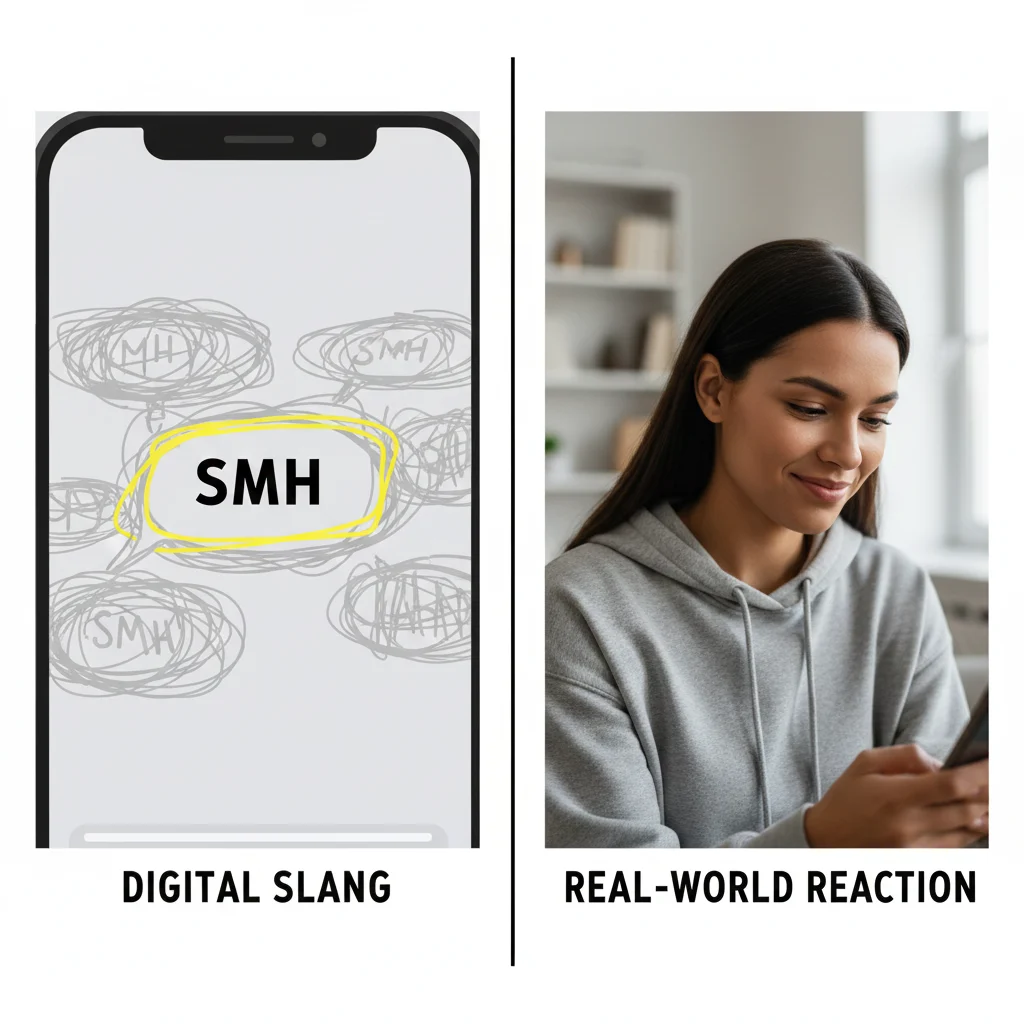
At its core, SMH is an initialism for “Shaking My Head.” It’s a non-verbal reaction turned into text, capturing the physical gesture of lowering your head and shaking it side-to-side in response to something you find foolish, frustrating, illogical, or just plain unbelievable.
Think of it as the written equivalent of a facepalm 🤦♀️ or a heavy sigh. It conveys a mix of disbelief, disappointment, and mild (or sometimes major) annoyance, all wrapped up in three letters.
Example: “He tried to microwave a metal spoon… smh.”
In short: SMH = Shaking My Head = A digital expression of disbelief or disappointment.
📱 Where Is SMH Commonly Used?
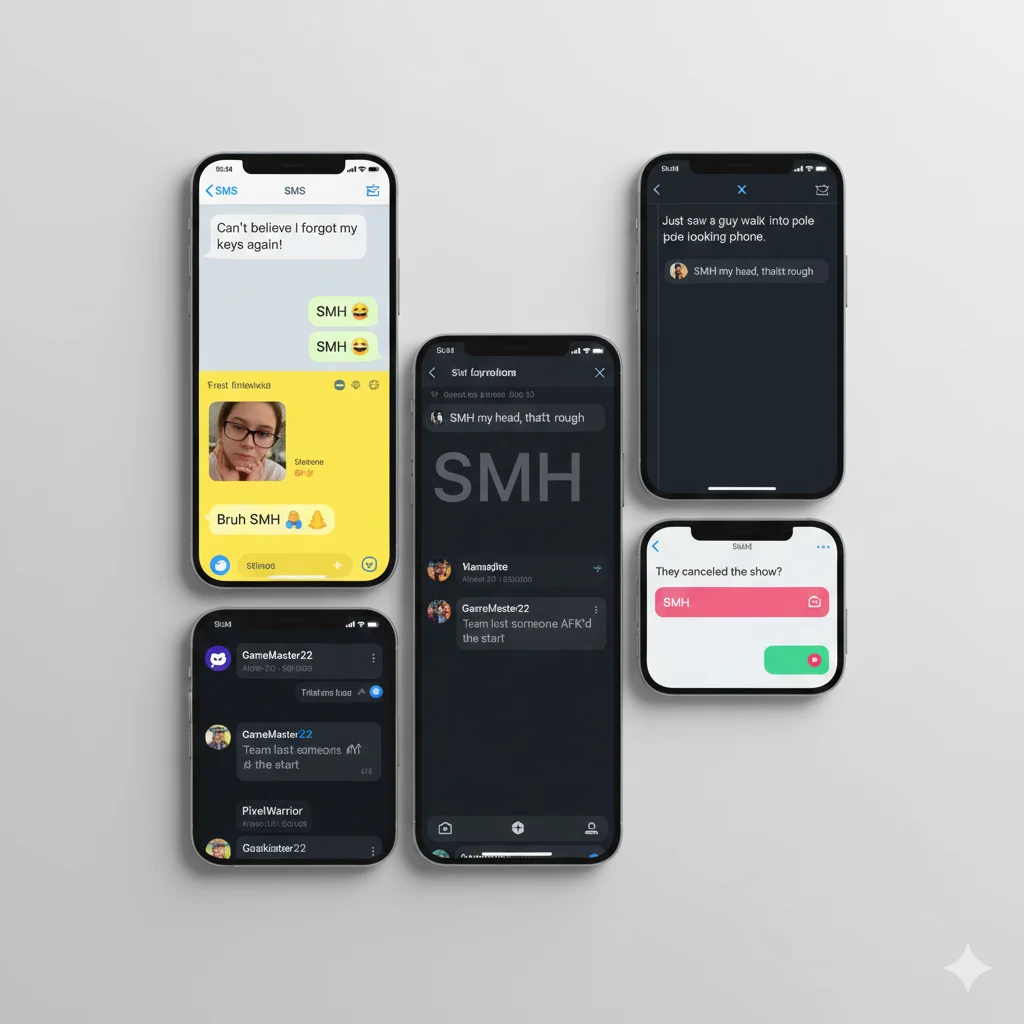
SMH is a veteran of internet slang, thriving anywhere informal communication happens:
- Text Messaging 📱: The #1 home for quick “smh” reactions between friends.
- Social Media Comments (Facebook, Instagram, Twitter/X): A popular reply to outrageous posts or comments.
- Gaming Chats 🎮: Used when a teammate makes a baffling move.
- Forums & Discussion Boards (Reddit, etc.): A common reaction to frustrating or ignorant posts.
Tone: SMH is decidedly casual and informal. It’s for friends, peers, and informal online spaces. It is not social-media–friendly in professional contexts or serious discussions.
💬 Examples of SMH in Conversation
Here’s how SMH flows in real, authentic chats:
- Reacting to a silly mistake:A: i just spent 10 mins looking for my phone… while i was talking on it
B: bro… smh 😂 - Responding to bad decisions:A: he bought tickets without checking the date and now he can’t go
B: absolute legend. smh. - In a group chat drama:A: so she said she’s busy, but her story shows her at the movies…
B: smh. the audacity. - Commenting on general foolishness:A: this article says drinking bleach cures the common cold
B: smh. the internet was a mistake. - Self-deprecating use:A: locked my keys in the car. again. smh at myself.
- With intensifiers:A: they raised the price but made the package smaller
B: smh my damn head. (A common intensified variant for extra emphasis).
🕓 When to Use and When Not to Use SMH
✅ When to Use SMH:
- With close friends and family in casual chats.
- Reacting to obvious foolishness, irony, or minor disappointments online.
- When you want to express exasperation without typing a long paragraph.
- In memes or humorous content.
❌ When NOT to Use SMH:
- In formal emails, work chats (like Slack/Teams), or professional correspondence.
- During serious conversations where empathy is needed (e.g., someone sharing a real problem).
- With superiors, clients, or people you don’t know well.
- When genuine anger or a serious response is warranted—it can come off as dismissive.
Context Comparison Table
| Context | Example Phrase | Why It Works (or Doesn’t) |
|---|---|---|
| Friend Chat | “He forgot his own birthday… smh 🤦♂️” | Perfectly casual & expresses shared disbelief. |
| Work Chat | “The client changed requirements again.” (Avoid SMH; use words) | SMH is too informal/unprofessional. A written sigh is better. |
| Serious Talk | “I’m really struggling with this.” | Do not use SMH. It minimizes their feelings. Use “I’m sorry to hear that” or “That sounds tough.” |
| Social Media Comment | On a post about historical inaccuracy in a movie: “The Romans didn’t have telescopes. SMH.” | Appropriate for casual public commentary. |
🔄 Similar Slang Words or Alternatives
SMH is part of a family of text-based reactions. Here are its cousins:
| Slang | Meaning | When to Use It |
|---|---|---|
| Facepalm 🤦 | The emoji/picture version of SMH. | When an emoji says it better than letters. Great for visual emphasis. |
| FFS | For F***’s Sake. | A much stronger, more explicit reaction to extreme frustration or anger. Use with extreme caution. |
| I Can’t (or I Cant) | I can’t even deal with this. | For when something is so overwhelming (good or bad) you’re speechless. Often used humorously. |
| Bruh | A versatile term for “bro,” often used as an exclamation of disbelief. | “Bruh… what were you thinking?” Very casual, peer-to-peer. |
| Dead 💀 | “I’m dead from laughter” or shock. | Reacting to something extremely funny or shocking. “OMG that video… I’m dead. smh.” |
| FML | F*** My Life. | For reacting to a personally unfortunate or embarrassing situation. More self-directed than SMH. |
❓ FAQs About SMH
Q: Does SMH ever have a dirty meaning?
A: Almost never. This is a persistent internet myth or misunderstanding. Its standard meaning is “Shaking My Head.” In extremely rare, niche contexts online, some jokingly reinterpret it as “So Much Hate” or other phrases, but “Shaking My Head” is universal.
Q: What about SMH my head? Isn’t that redundant?
A: Yes! “SMH my head” literally reads as “Shaking My Head my head.” This is an intentional, humorous redundancy used online for extra emphasis, similar to “ATM machine.” It’s slang evolving for effect.
Q: Is SMH rude?
A: It can be perceived as dismissive or condescending if used in the wrong context (e.g., to someone sharing a genuine effort or problem). With friends about a funny fail, it’s fine. In an argument or serious talk, it’s likely rude.
Q: How do I respond to SMH?
A: Often, it doesn’t require a response—it’s a reaction. You might laugh it off (😂), agree (“I know, right?”), or explain further if someone is genuinely confused by your action.
Conclusion
So, the next time you see “smh,” you can confidently read it as a digital head shake—not a secret code. It’s the punctuation of exasperation in our modern texting vocabulary, a quick way to say, “Wow, that’s something,” without having to spell it out. The search for a “dirty meaning” is a classic case of the internet reading too much into things. Now that you’re an expert, you can use SMH appropriately, avoid awkward misunderstandings, and maybe even explain it to the next person who asks. Just don’t use it in an email to your boss… unless you want them to be the one shaking their head.

James Thornton is a researcher and writer focused on sleep science, lucid dreaming, and the neurological aspects of dream formation. With a strong academic foundation in cognitive science, James specializes in analyzing how dreams influence memory, creativity, and emotional health. His contributions to DreamingSign.com are well-known for their scientific accuracy and thought-provoking insights, helping readers understand the powerful connection between the brain and the dream world.